Expert air conditioning advice
Portable vs Split Air Conditioning for London Homes
Compare portable and split air conditioning for London homes: exhaust setup, bedroom noise, installation, running costs and permissions, plus 15 FAQs.
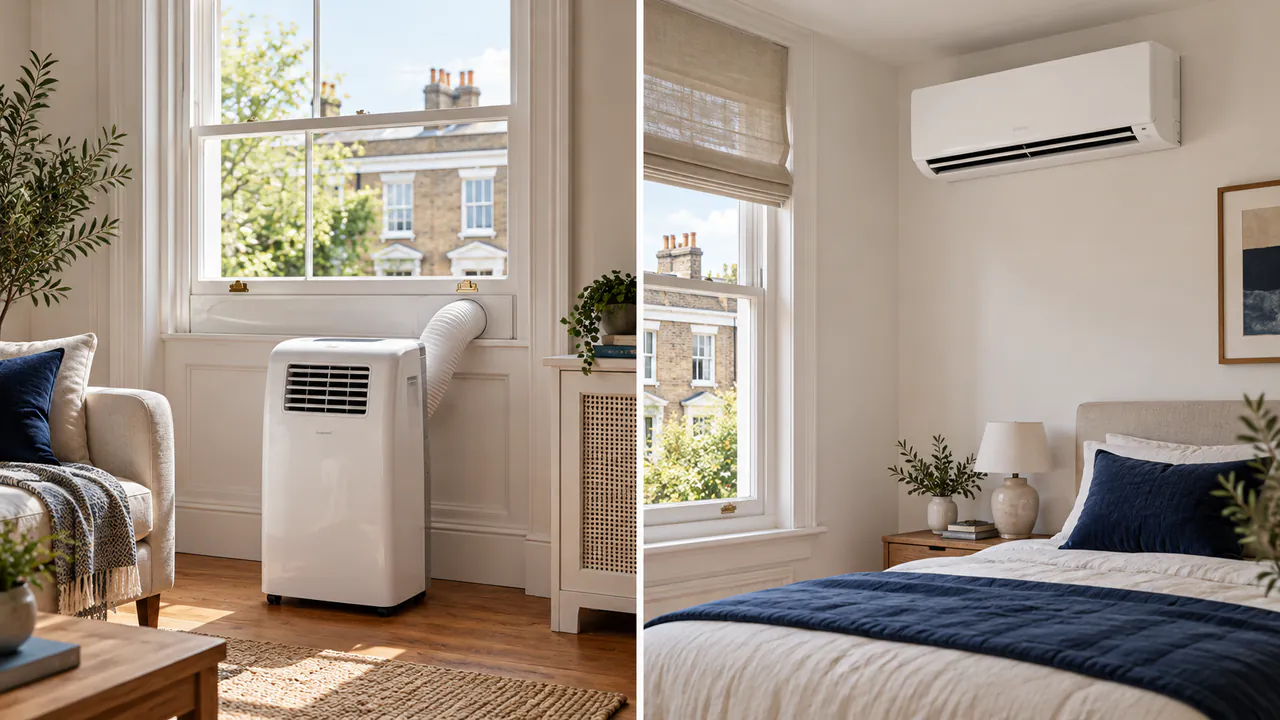
Choosing portable versus split air conditioning for a London home comes down to installation feasibility, how often you need cooling and the comfort you expect. A portable unit can be a practical temporary option where a suitable exhaust route exists. A fixed split can suit regular use, but it needs a designed installation and an acceptable outdoor-unit position.
The right comparison includes purchase and installation costs, room noise, heat rejection, permissions, electricity use and maintenance. A cheap appliance that cannot be vented properly is not a solution, while a permanent installation may be unnecessary for a room used only occasionally.
This guide focuses on conventional portable room air conditioners and fixed split systems. Product designs vary, so check the manual for the exact equipment. If you are deciding whether to install anything at all, start with whether air conditioning is worthwhile in London.
Portable and split AC compared at a glance
| Factor | Portable room AC | Fixed split AC |
|---|---|---|
| Installation | Usually needs an approved exhaust arrangement at a window or opening | Needs indoor/outdoor equipment, pipework, drainage, electrics and commissioning |
| Location | Floor space close to a suitable exhaust point | Indoor position plus an acceptable outdoor location |
| Sound | Compressor and fan are commonly inside the room | Indoor fan sound plus outdoor equipment sound |
| Moving rooms | Possible if the next room also has a suitable setup | Not intended for routine relocation |
| Ownership commitment | Often easier for temporary use | More suited to a planned longer-term installation |
| Cost comparison | Purchase, accessories, electricity and storage | Installed price, electricity, maintenance and future access |
Neither column gives an automatic winner. A tenant with a suitable sash-window adapter may find a portable unit useful, while an owner using a bedroom throughout summer may prefer a well-designed split. Conversely, a split is not feasible simply because it is the preferred technology: the building and permissions still have to work.
Compare equivalent outcomes. Decide which room, what hours and what degree of comfort you need before comparing prices. Otherwise, you may be comparing a temporary cooling aid with a system designed to maintain several occupied rooms.
What a portable air conditioner actually needs
A conventional portable compressor air conditioner removes heat from the room and rejects it through an exhaust arrangement. It cannot deliver sustained room cooling while returning all that heat to the same enclosed space. Check the supplied hose, approved adapter and permitted installation arrangement before buying.
De'Longhi's portable ventilation guidance describes connecting the exhaust hose to a window bracket. The manufacturer's hose guidance also warns against extending its hose. Treat these as examples of model-specific instructions, not permission to improvise a route for another appliance.
Check your window type. Sash, casement and inward-opening windows may need different adapters, and a supplied kit may not fit all of them. Think about rain, security, window restrictors and the ability to close the opening when the unit is not operating. Avoid blocking an escape route or defeating a required safety feature.
Allow space around the appliance as specified and consider the route of the cable and hose. A unit on wheels still needs a stable, suitable position. It should not turn a narrow bedroom or hallway into an obstacle course simply because it fits beside the bed.
What a split-system installation involves
A fixed split normally places an indoor unit in the room and connects it to an outdoor unit using refrigerant pipework and associated services. The installer must assess capacity, airflow, supports, electrical supply and condensate drainage. The equipment pairing and pipe limits come from the selected manufacturer's requirements.
A short, accessible route can simplify the job. A route across several rooms or to an upper-floor exterior position can be more involved. Ask for a drawing showing where the services will run and how the finish will look. Concealed routes need maintenance access and may involve making-good or decorating outside the installer's scope.
Commissioning and handover matter as much as mounting the units. Ask what records, manuals, control instructions and warranty information you will receive. Use our installer credentials checklist to verify the business doing the regulated work, rather than relying only on an equipment brand name.
The installation overview explains the survey questions. If more than one room needs conditioning, our single-split versus multi-split guide helps compare a shared outdoor unit with separate systems.
Noise and bedroom comfort
With many portable units, the compressor operates inside the room along with the fan. That can matter when trying to sleep, hold a video call or listen to television quietly. Listen to the actual model where possible, and distinguish fan-only demonstrations from active cooling.
A split moves major machinery outdoors, but the indoor unit still produces airflow sound and may have a condensate pump. Outdoor sound also needs consideration at your own and neighbouring rooms. “Quiet indoor mode” should never be treated as proof that a proposed external position is suitable.
Compare sound data on a consistent basis: the same measurement type, operating mode and relevant conditions. A lowest-speed figure for one product and a maximum-output figure for another do not make a fair comparison. Ask what happens to cooling output when the quietest mode is used.
Position affects comfort too. A strong stream of cold air aimed directly at a bed or desk can be unpleasant even if the room temperature is acceptable. Discuss furniture layout and airflow direction before choosing the location. A better-positioned system can be more comfortable without needing an aggressively low thermostat setting.
Purchase price, installed price and running costs
A portable unit usually involves a smaller initial commitment than a professionally installed fixed split, but the comparison should include required window accessories and any safe setup work. Do not compare an equipment-only split-system listing with a portable appliance that is ready for use.
Use our London installation price guide to understand the components of a fixed-system quote. Ask whether electrical work, drainage, access and making-good are included. A more expensive installation can reflect a difficult building rather than a more powerful or efficient product.
For running costs, compare the electricity needed to deliver the comfort you want. Rated wattage alone does not capture all differences in output, control or installation. A portable unit with a poorly sealed window can be working against avoidable heat entry. A fixed system can also perform poorly if badly sized or maintained.
The running-cost guide uses explicit assumptions and a calculation you can adapt. When considering payback, use realistic operating hours. An efficiency saving accumulated over a few hot evenings is different from one accumulated through a full working summer.
Renters, flats and permanent alterations
A portable unit may avoid some permanent alterations, but it is not permission to modify a rented window, drill a wall or obstruct shared space. Check your tenancy and building arrangements before making changes. If a window adapter is proposed, consider whether it is reversible and acceptable to the owner.
A split system usually requires a more detailed conversation about the exterior and services. Owning a leasehold flat does not necessarily give you control of the outside wall or balcony structure. Read our London flat guide before assuming the outdoor unit can be installed wherever it physically fits.
The planning guide explains why lease consent, planning and building regulations are separate checks. “No outdoor condenser” is also not a universal exemption: other equipment can require external openings or internal alterations that need their own assessment.
For an apartment in Notting Hill or a converted property in Camden Town, identify the actual building restrictions first. Area coverage does not imply that every cooling option is suitable for every address.
Fans, air coolers and other alternatives
Check what a product actually is. A fan moves air; an evaporative cooler uses evaporation; a compressor air conditioner transfers heat using a refrigeration process. Similar product names and marketing images can obscure these differences. A device described as a “personal cooler” should not be assumed to perform like room AC.
Energy Saving Trust's cooling guidance distinguishes these options and recommends measures such as shading and using cooler outdoor air when appropriate. Start with practical ways of reducing heat gain before selecting mechanical cooling capacity.
Assess ventilation safely. An opening that helps release heat may also raise security, noise or outdoor-air concerns. A fan can make occupants feel more comfortable without achieving the room-temperature reduction required for a particular activity. Judge each option against the actual problem you are trying to solve.
If the room is under the roof, improving the cooling strategy may involve more than changing appliances. Our loft and top-floor guide explains the role of glazing, roof exposure and room layout when preparing for a survey.
A practical decision process for your home
First, identify the cooling need and expected duration of use. Then test feasibility: a portable needs an approved exhaust setup, while a split needs an acceptable outdoor location and service route. If either option fails that test, do not let a discount or strong review override the physical constraint.
Next, compare the experience of using it. Consider noise, floor space, airflow, controls and whether someone must repeatedly fit and remove a window kit. For a permanent system, consider the appearance and access for future maintenance.
Finally, compare complete costs over the period you expect to use the equipment. Include sensible allowances for care and storage, and identify who deals with faults. If you already own a split system that underperforms, a professional fault assessment may be more useful than buying a portable replacement.
If fixed cooling looks appropriate, send your room and property details. D17 Air Conditioning is an installer-matching service; an independent installer assesses the proposed system and provides its own specification and quotation. There is no obligation to choose a permanent installation simply because you have explored the option.
15 FAQs about portable versus split air conditioning
1. Is a portable air conditioner worth buying?
It can be worthwhile for temporary or occasional cooling when the room has a suitable exhaust arrangement and the sound is acceptable. Check the window kit, floor space and operating instructions before buying. A portable unit is less useful if you cannot vent it correctly or need reliable conditioning across several separate rooms.
2. Can a portable air conditioner cool without a hose?
A conventional portable compressor unit needs an approved way to reject heat outside the cooled space. Operating it without that arrangement does not provide sustained net room cooling. Fan-only and dehumidifying modes may have different instructions, so consult the specific manual rather than assuming every mode or product behaves the same way.
3. Can I put the exhaust hose into another room?
That transfers heat into the adjoining space rather than removing it from the home, and may not be an approved installation arrangement. Follow the manufacturer's instructions for the exact appliance. Do not vent into a ceiling void, enclosed cupboard or shared corridor as an improvised substitute for a suitable outdoor exhaust route.
4. Can I extend the portable unit's hose?
Only use arrangements expressly permitted by the manufacturer. Extra length, bends or unsuitable fittings can affect operation. Check the required position before purchasing so the supplied or approved hose reaches the intended exhaust point. Avoid buying an appliance first and then trying to solve a poor location with improvised extensions.
5. Will a portable unit work with a sash window?
It may, with a compatible adapter and an arrangement that meets the appliance instructions and property restrictions. Measure the opening and check the kit before ordering. Consider weather, security and closing the window when not in use. A generic window-kit image is not proof that the accessory fits your particular sash.
6. Which option is better for sleeping?
A well-designed split can be attractive for regular bedroom use because major machinery is outdoors, but compare actual indoor sound, airflow and any drain pump. Portable units vary and may be acceptable to some sleepers. Avoid choosing from a single lowest-noise figure without understanding the cooling mode and conditions used to measure it.
7. Are portable air conditioners always inefficient?
Performance varies by product and setup. Exhaust arrangements, sealing and room conditions influence the useful cooling delivered. Compare appropriate efficiency data and real operating requirements rather than making a blanket claim about every portable design. The practical question is whether the appliance can provide your required comfort at an acceptable total cost.
8. Can I install a fixed split myself?
A split installation involves work that requires suitable professional competence, including regulated refrigerant activities where applicable and electrical work. Use an appropriately qualified business and verify its credentials. Plugging in a self-contained portable appliance according to its manual is a different task from connecting and commissioning a fixed refrigerant system.
9. Does a split system need a large hole through the wall?
It needs a suitable route for its services, but the exact penetration depends on the design and equipment. Ask the installer to show the proposed location, size, sealing and finish. Do not drill in advance based on a generic online measurement, particularly in a flat or where structural, fire or heritage considerations apply.
10. Can I move a portable unit between rooms every day?
Possibly, but both rooms need suitable exhaust arrangements and enough space. Consider the appliance's weight, thresholds, stairs and instructions for moving it. Repeatedly relocating a hose and window kit can become inconvenient. If several rooms need cooling simultaneously, one moveable appliance will not provide the same service as separate room units.
11. Does a portable unit need draining?
Drainage requirements vary with the appliance, operating mode and conditions. Some collect water or need a drain connection in particular modes. Read the manual and check how you will access the drain safely. Do not assume that a description such as “self-evaporating” means no maintenance or water management is ever needed.
12. Is a split system always the cheapest long-term option?
No. The answer depends on installed price, operating hours, performance, maintenance and how long you keep the property. Occasional use may not justify a major installation solely through electricity savings. Compare realistic scenarios and include comfort, noise and convenience, rather than presenting a guaranteed payback period unsupported by your actual usage.
13. Do both types provide heating?
Some products provide heating and others do not. Check the exact model and whether heating uses a reversible heat-pump process or another method. Also check the permitted operating conditions and drainage requirements. A product category name is not enough to establish its winter capability or the running cost of that function.
14. Is an air cooler the same as portable AC?
No. Evaporative coolers and compressor air conditioners use different processes and have different room effects and operating requirements. Look beyond marketing terms such as “cooling tower”. Establish whether the appliance uses refrigerant, needs an exhaust and adds moisture. Choose according to the room conditions and the outcome you actually need.
15. What should I choose if I plan to move soon?
Consider the remaining period of use, the permissions available and whether a moveable appliance can be used at the next property. A fixed system may still offer comfort benefits, but do not assume you will recover its cost through a sale. Assess the immediate need and avoid a permanent commitment based on speculative resale value.